Filters
Question type

Study Flashcards

Select the nuclide that completes the following nuclear reaction Select the nuclide that completes the following nuclear reaction   ? A)    B)    C)    D)    E)  None of these choices is correct. ?


A) Select the nuclide that completes the following nuclear reaction   ? A)    B)    C)    D)    E)  None of these choices is correct.
B) Select the nuclide that completes the following nuclear reaction   ? A)    B)    C)    D)    E)  None of these choices is correct.
C) Select the nuclide that completes the following nuclear reaction   ? A)    B)    C)    D)    E)  None of these choices is correct.
D) Select the nuclide that completes the following nuclear reaction   ? A)    B)    C)    D)    E)  None of these choices is correct.
E) None of these choices is correct.

F) C) and E)
G) All of the above

Correct Answer

verifed

verified

In the equation below, what particle or type of radiation needs to be included to balance the equation? 208Pb → ? + 204Hg


A) Gamma particle
B) Alpha particle
C) Proton
D) Beta particle
E) Positron

F) A) and B)
G) B) and E)

Correct Answer

verifed

verified

If a captured electron combines with a proton in the nucleus to form a neutron, what happens to the atomic number and the mass number?

Correct Answer

verifed

verified

The atomic number de...

View Answer

How old is the oldest object that can reliably be dated using 14C dating?


A) 5730 years
B) 30,000 years
C) 60,000 years
D) 10,000 years
E) There is no limit to how old an object can be.

F) A) and E)
G) A) and D)

Correct Answer

verifed

verified

Naturally occurring uranium contains approximately 1% U-235 and 99% U-238. Of these, the isotope that undergoes fission in a nuclear reactor is U-238.

A) True
B) False

Correct Answer

verifed

verified

In a nuclear reaction elements are converted to other elements.

A) True
B) False

Correct Answer

verifed

verified

A sample of a radioisotope shows an activity of 999 disintegrations per minute due to beta decay. If after 1.10 years the activity is 952 disintegrations per minute, what is the half-life of this radioisotope?


A) 4.38 × 10⁻² yr
B) 11.4 yr
C) 0.25 yr
D) 15.8 yr
E) 9.1 yr

F) A) and D)
G) A) and C)

Correct Answer

verifed

verified

Rubidium-87 decays by beta decay with a half-life of 4.9 × 10¹⁰ yr. How many 87Rb atoms are in a moon rock sample that has a rubidium decay rate of 3500 disintegrations per hour?


A) 9.0 × 10¹⁶ atoms
B) 4.3 × 10⁻⁴ atoms
C) 2.2 × 10¹⁸ atoms
D) 2.5 × 10¹⁴ atoms
E) 1.7 × 10¹⁴ atoms

F) A) and C)
G) A) and E)

Correct Answer

verifed

verified

What is the name given to the nuclear process that results from the bombardment of nuclei by neutrons, protons, or other nuclei?


A) Nuclear transmutation
B) Protonation
C) Nucleation
D) Nuclear condensation
E) Radioactivity

F) C) and D)
G) A) and B)

Correct Answer

verifed

verified

Which of the following is used to test the activity of the thyroid?


A) (18O)
B) (131I)
C) (123I)
D) (24Na)
E) (99Tc)

F) A) and C)
G) A) and B)

Correct Answer

verifed

verified

What other particle is emitted when a neutron is converted to a proton in a nucleus?


A) Gamma particle
B) Alpha particle
C) Positron
D) Beta particle
E) None of the answers is correct.

F) B) and D)
G) A) and D)

Correct Answer

verifed

verified

What fraction of radioactive atoms remains in a sample after six half-lives?


A) zero
B) 1/6
C) 1/16
D) 1/32
E) 1/64

F) A) and E)
G) C) and E)

Correct Answer

verifed

verified

Calculate the energy released in joules when one mole of polonium-214 decays according to the following equation. Calculate the energy released in joules when one mole of polonium-214 decays according to the following equation.     (1 kg = 6.022 × 10<sup>26</sup> amu; N<sub>A</sub> = 6.022 × 10<sup>23</sup> mol<sup>-1</sup>; C = 2.99792458 × 10<sup>8</sup> m/s)  A)  8.78 × 10<sup>14</sup> J/mol B)  7.2 × 10<sup>14</sup> J/mol C)  8.76 × 10<sup>11</sup> J/mol D)  -9.75 × 10<sup>-3</sup> J/mol E)  1.46 × 10<sup>-9</sup> J/mol Calculate the energy released in joules when one mole of polonium-214 decays according to the following equation.     (1 kg = 6.022 × 10<sup>26</sup> amu; N<sub>A</sub> = 6.022 × 10<sup>23</sup> mol<sup>-1</sup>; C = 2.99792458 × 10<sup>8</sup> m/s)  A)  8.78 × 10<sup>14</sup> J/mol B)  7.2 × 10<sup>14</sup> J/mol C)  8.76 × 10<sup>11</sup> J/mol D)  -9.75 × 10<sup>-3</sup> J/mol E)  1.46 × 10<sup>-9</sup> J/mol (1 kg = 6.022 × 1026 amu; NA = 6.022 × 10²³ mol-1; C = 2.99792458 × 10⁸ m/s)


A) 8.78 × 10¹⁴ J/mol
B) 7.2 × 10¹⁴ J/mol
C) 8.76 × 10¹¹ J/mol
D) -9.75 × 10⁻³ J/mol
E) 1.46 × 10⁻⁹ J/mol

F) A) and E)
G) A) and B)

Correct Answer

verifed

verified

The half-life of 14C is 5730 yr. Assuming some charcoal from a campfire 29,000 years old was found, what fraction of the original C-14 would remain today?


A) 3.0 × 10⁻²
B) 0.20
C) 3.5
D) 0.33
E) 0.29

F) A) and B)
G) A) and C)

Correct Answer

verifed

verified

Which of the following is used to image the brain?


A) (18O)
B) (131I)
C) (123I)
D) (24Na)
E) (99Tc)

F) B) and C)
G) A) and E)

Correct Answer

verifed

verified

Exposure to 10 nCi for 10 minutes is more hazardous for a child than for an adult because


A) the child's cells are dividing more rapidly than the adult's and are, therefore, more susceptible to the radiation.
B) the child's smaller body size makes the effective dose larger for the child than for the adult.
C) the child's immune system is not developed well enough to resist damage.
D) the child's skin is not as thick as an adult's and cannot block as much radiation.
E) None of these reasons is correct.

F) C) and D)
G) A) and E)

Correct Answer

verifed

verified

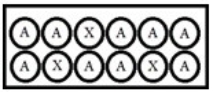
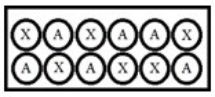
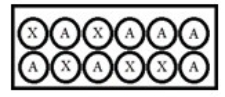
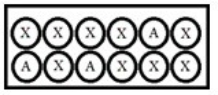
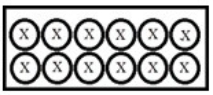
In the following diagrams, A represents a radioactive isotope that decays into a new isotope, X. Each circle represents 1 mmol of atoms. t = 0: In the following diagrams, A represents a radioactive isotope that decays into a new isotope, X. Each circle represents 1 mmol of atoms. t = 0:   t = 25.0 s:   Which diagram best represents the sample at t = 50.0 s? A)    B)    C)    D)    E)   t = 25.0 s: In the following diagrams, A represents a radioactive isotope that decays into a new isotope, X. Each circle represents 1 mmol of atoms. t = 0:   t = 25.0 s:   Which diagram best represents the sample at t = 50.0 s? A)    B)    C)    D)    E)   Which diagram best represents the sample at t = 50.0 s?


A) In the following diagrams, A represents a radioactive isotope that decays into a new isotope, X. Each circle represents 1 mmol of atoms. t = 0:   t = 25.0 s:   Which diagram best represents the sample at t = 50.0 s? A)    B)    C)    D)    E)
B) In the following diagrams, A represents a radioactive isotope that decays into a new isotope, X. Each circle represents 1 mmol of atoms. t = 0:   t = 25.0 s:   Which diagram best represents the sample at t = 50.0 s? A)    B)    C)    D)    E)
C) In the following diagrams, A represents a radioactive isotope that decays into a new isotope, X. Each circle represents 1 mmol of atoms. t = 0:   t = 25.0 s:   Which diagram best represents the sample at t = 50.0 s? A)    B)    C)    D)    E)
D) In the following diagrams, A represents a radioactive isotope that decays into a new isotope, X. Each circle represents 1 mmol of atoms. t = 0:   t = 25.0 s:   Which diagram best represents the sample at t = 50.0 s? A)    B)    C)    D)    E)
E) In the following diagrams, A represents a radioactive isotope that decays into a new isotope, X. Each circle represents 1 mmol of atoms. t = 0:   t = 25.0 s:   Which diagram best represents the sample at t = 50.0 s? A)    B)    C)    D)    E)

F) A) and B)
G) C) and E)

Correct Answer

verifed

verified

Which of the following is an advantage of nuclear power plants over coal-burning plants? Nuclear power plants


A) form numerous radioactive fission products.
B) do not pollute the air with SO2, soot, and fly-ash.
C) produce more thermal pollution than coal plants.
D) use more fuel.

E) B) and D)
F) B) and C)

Correct Answer

verifed

verified

An alpha particle is a helium atom.

A) True
B) False

Correct Answer

verifed

verified

Which type of nuclear process requires an extremely high temperature (millions of degrees) ?


A) Beta decay
B) Fission reaction
C) Fusion reaction
D) Alpha decay
E) Positron emission

F) B) and E)
G) A) and B)

Correct Answer

verifed

verified

Showing 61 - 80 of 127

Related Exams

Show Answer