Filters
Question type

Study Flashcards

A(n)_______________ increases the reaction rate without being consumed.

Correct Answer

verifed

verified

The rate constant for a reaction is 4.65 L • mol-1 • s-1.What is the overall order of the reaction?


A) Zero
B) First
C) Second
D) Third
E) More information is needed to determine the overall order.

F) None of the above
G) D) and E)

Correct Answer

verifed

verified

For the overall chemical reaction shown below,which one of the following statements can be rightly assumed? 2 H2S(g) + O2(g) → 2S(s) + 2H2O(l)


A) The reaction is third-order overall.
B) The reaction is second-order overall.
C) The rate law is: rate = k[H2S]2 [O2].
D) The rate law is: rate = k[H2S] [O2].
E) The rate law cannot be determined from the information given.

F) A) and C)
G) B) and E)

Correct Answer

verifed

verified

The rate law for the reaction H2O2 + 2H+ + 2I- → I2 + 2H2O is rate = k[H2O2][I-].The following mechanism has been suggested. H2O2 + I- → HOI + OH- (slow) OH- + H+ → H2O (fast) HOI + H+ + I- → I2 + H2O (fast) Identify all intermediates included in this mechanism.


A) H+and I-
B) H+ and HOI
C) HOI and OH-
D) H+only
E) H2O and OH-

F) None of the above
G) D) and E)

Correct Answer

verifed

verified

The reaction A + 2B → products was found to have the rate law,rate = k[A][B]2.Predict by what factor the rate of reaction will increase when the concentration of A is doubled and the concentration of B is also doubled.


A) 2
B) 4
C) 6
D) 8
E) 9

F) A) and B)
G) A) and C)

Correct Answer

verifed

verified

The intermediate in a reaction appears in the mechanism of the reaction and in the overall balanced equation.

A) True
B) False

Correct Answer

verifed

verified

A _________-__________________ is a reaction whose rate depends on the concentration of one of the reactants raised to the first power.

Correct Answer

verifed

verified

first-orde...

View Answer

The _______________ is the rate for a specific instant in time.

Correct Answer

verifed

verified

Consider the following potential energy profile for the A → B reaction.How many elementary steps are there? Consider the following potential energy profile for the A → B reaction.How many elementary steps are there?   A) 1 B) 2 C) 3 D) 4 E) 5


A) 1
B) 2
C) 3
D) 4
E) 5

F) C) and D)
G) A) and E)

Correct Answer

verifed

verified

A catalyst increases the rate of the reaction and is recovered completely at the end of the reaction.

A) True
B) False

Correct Answer

verifed

verified

The following diagram represents the second-order decomposition of A to form X according to the following balanced chemical equation: A → X.Each sphere represents 1.0 mmol of atoms,and the volume of the box is 1.0 L. The following diagram represents the second-order decomposition of A to form X according to the following balanced chemical equation: A → X.Each sphere represents 1.0 mmol of atoms,and the volume of the box is 1.0 L.   What is the half-life of the reaction? A) 15 s B) 30 s C) 36 s D) 45 s E) 60 s What is the half-life of the reaction?


A) 15 s
B) 30 s
C) 36 s
D) 45 s
E) 60 s

F) A) and E)
G) B) and C)

Correct Answer

verifed

verified

A rate constant obeys the Arrhenius equation,the factor A being 2.2 × 10¹³ s-1 and the activation energy being 150.kJ mol-1.What is the value of the rate constant at 227°C? (R = 8.314 J/mol• K)


A) 2.1 × 10¹³ s-1
B) 6.7 × 10⁻²² s-1
C) 1.5 × 10¹¹ s-1
D) 4.7 × 10⁻³ s-1
E) 1.0 × 1029 s-1

F) A) and C)
G) A) and B)

Correct Answer

verifed

verified

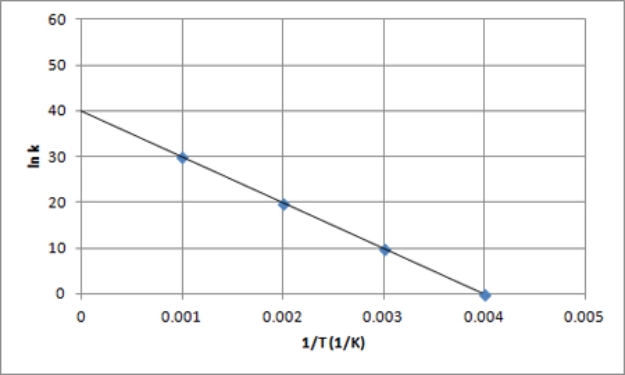
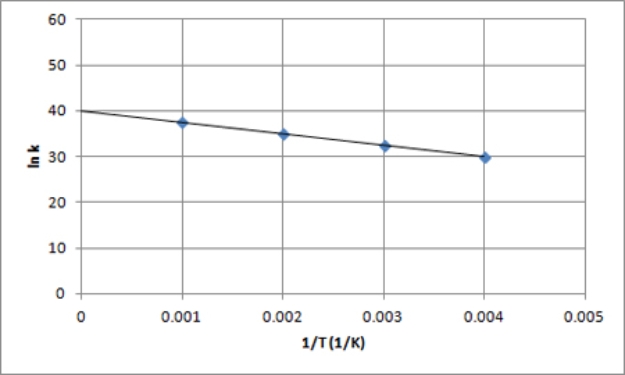
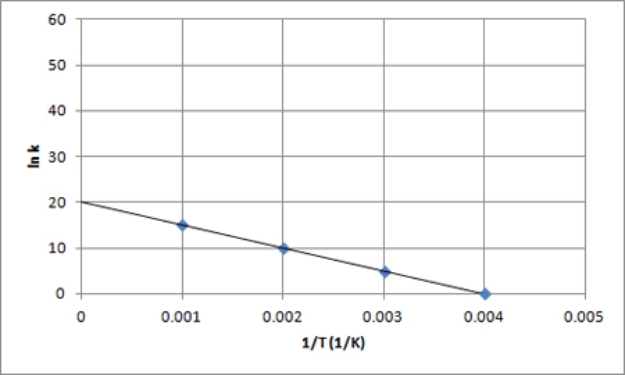
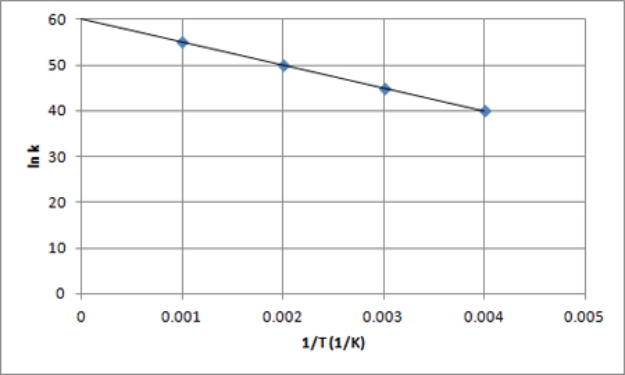
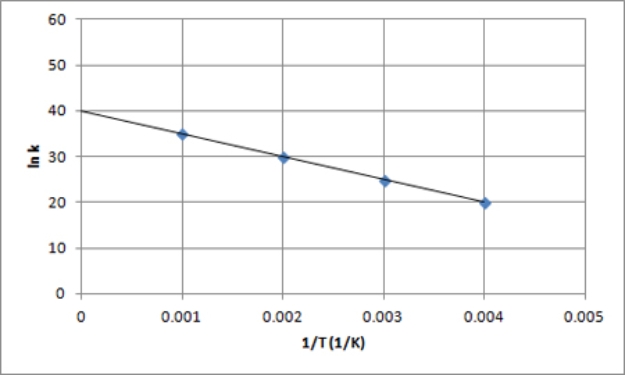
The following is an Arrhenius plot of a first-order reaction.The rate constant is measured in units of s-1. The following is an Arrhenius plot of a first-order reaction.The rate constant is measured in units of s<sup>-1</sup>.   If a catalyst is added to the reaction,which could correspond to an Arrhenius plot of the catalyzed reaction? A)    B)    C)    D)    E)   If a catalyst is added to the reaction,which could correspond to an Arrhenius plot of the catalyzed reaction?


A) The following is an Arrhenius plot of a first-order reaction.The rate constant is measured in units of s<sup>-1</sup>.   If a catalyst is added to the reaction,which could correspond to an Arrhenius plot of the catalyzed reaction? A)    B)    C)    D)    E)
B) The following is an Arrhenius plot of a first-order reaction.The rate constant is measured in units of s<sup>-1</sup>.   If a catalyst is added to the reaction,which could correspond to an Arrhenius plot of the catalyzed reaction? A)    B)    C)    D)    E)
C) The following is an Arrhenius plot of a first-order reaction.The rate constant is measured in units of s<sup>-1</sup>.   If a catalyst is added to the reaction,which could correspond to an Arrhenius plot of the catalyzed reaction? A)    B)    C)    D)    E)
D) The following is an Arrhenius plot of a first-order reaction.The rate constant is measured in units of s<sup>-1</sup>.   If a catalyst is added to the reaction,which could correspond to an Arrhenius plot of the catalyzed reaction? A)    B)    C)    D)    E)
E) The following is an Arrhenius plot of a first-order reaction.The rate constant is measured in units of s<sup>-1</sup>.   If a catalyst is added to the reaction,which could correspond to an Arrhenius plot of the catalyzed reaction? A)    B)    C)    D)    E)

F) B) and E)
G) A) and D)

Correct Answer

verifed

verified

Consider the reaction 2NH3(g) → N2(g) + 3 H2 (g) If the rate Δ[H2]/Δt is 0.030 mol L-1 • s-1,what is Δ[N H3]/Δt?


A) -0.045 mol L-1• s-1
B) -0.030 mol L-1• s-1
C) -0.020 mol L-1• s-1
D) -0.010 mol L-1• s-1
E) None of these choices is correct.

F) All of the above
G) C) and E)

Correct Answer

verifed

verified

A certain first-order reaction A → B is 25% complete in 42 min at 25°C.What is its rate constant?


A) 6.8 × 10⁻³ min-1
B) 8.3 × 10⁻³ min-1
C) 3.3 × 10⁻² min-1
D) -3.3 × 10⁻² min-1
E) 11 min-1

F) A) and B)
G) B) and D)

Correct Answer

verifed

verified

______________ describes the reaction rate as being directly proportional to the number of molecular collisions per second.

Correct Answer

verifed

verified

What statement below best describes the graph representing the integrated second-order rate law?


A) A plot of [A]t vs.t yields a straight line with a negative slope equal to -k.
B) A plot of 1/[A]t vs.t yields a straight line with a negative slope equal to k.
C) A plot of ln[A]t vs.t yields a straight line with a positive slope equal to -k.
D) A plot of ln[A]t vs.t yields a straight line with a negative slope equal to -k.
E) A plot of 1/[A]t vs.t yields a straight line with a positive slope equal to k.

F) A) and E)
G) A) and C)

Correct Answer

verifed

verified

The elementary reaction HBr(g)+ Br(g)→ H(g)+ Br2 (g)is endothermic.

Correct Answer

verifed

verified

Would you expect the rate constant for t...

View Answer

A first-order reaction has a rate constant of 7.5 × 10⁻³ s-1.The time required for the reaction to be 60% complete is?


A) 3.8 × 10⁻³ s
B) 6.9 × 10⁻³ s
C) 68 s
D) 120 s
E) 130 s

F) A) and E)
G) B) and D)

Correct Answer

verifed

verified

The reaction A + 2B → products has the rate law,rate = k[A][B]3.If the concentration of B is doubled while that of A is unchanged,by what factor will the rate of reaction increase?


A) 2
B) 4
C) 6
D) 8
E) 9

F) All of the above
G) C) and D)

Correct Answer

verifed

verified

Showing 21 - 40 of 114

Related Exams

Show Answer